


Hearing Loss Simulator
2026 ■ Web App / JavaScript
About
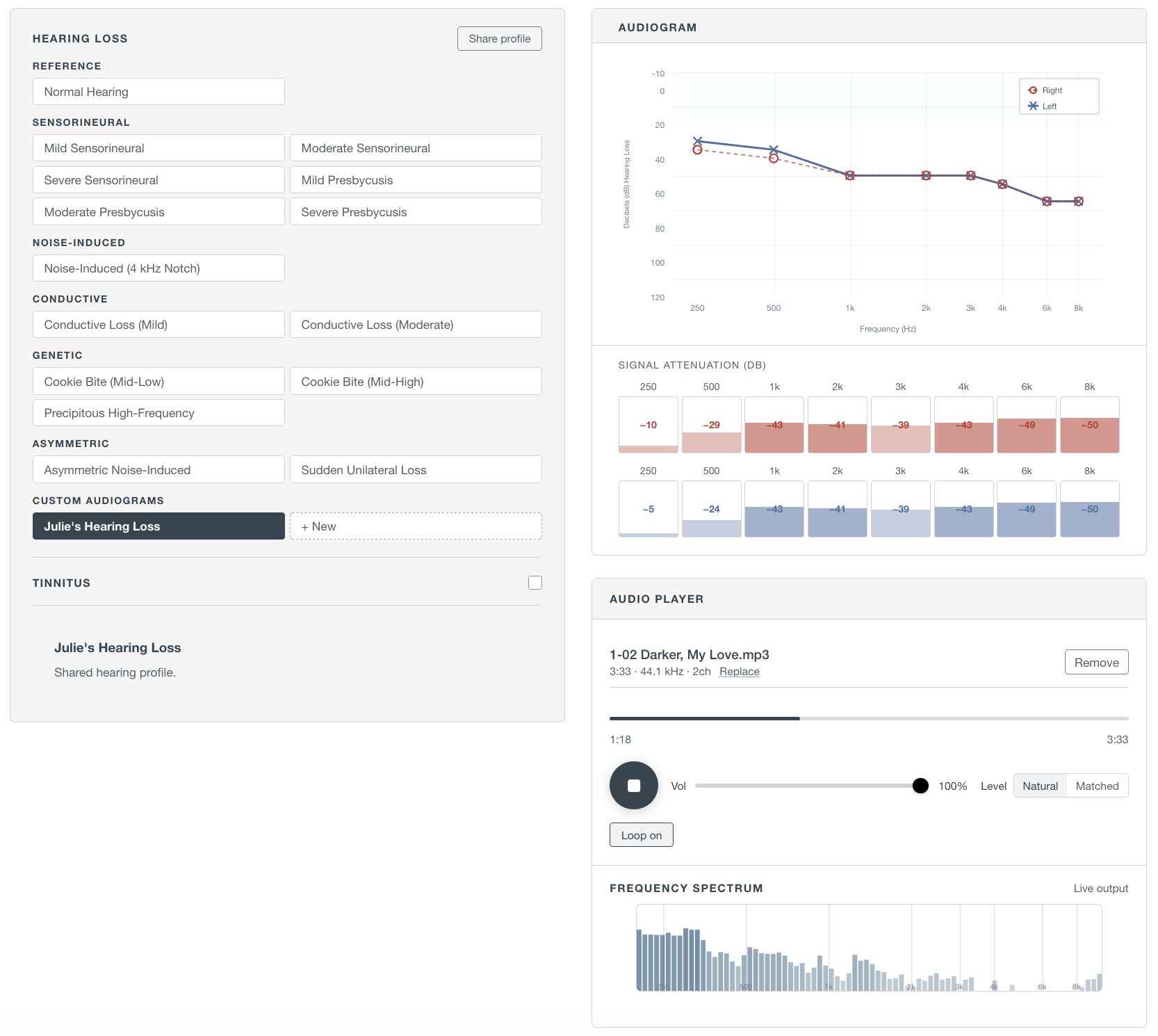
I created this simulator because while many hearing loss simulators exist online, they use preset audio files to demonstrate how parts of speech disappear at certain frequencies for particular types of hearing loss. I wanted to demonstrate hearing loss and its effect using music. This simulator includes several common preset hearing loss profiles as well as support for custom audiograms, and automatically applies the selected profile to audio of your choice. I have created a custom profile based upon my hearing loss that models my experience, including tinnitus.
Why?
I want other people to understand that I cannot naturally hear music in the same way. My mild-to-moderate sensorineural hearing loss was treated with hearing aids beginning at age 3, but they were essentially tiny speakers in my ear canals, optimized for conversational speech. Music came through distorted, compressed into the midrange, and stripped of its depth. I could wear headphones without hearing aids and simply turn up the volume, but it wasn’t a true solution.
For years, I would modify an equalizer to boost frequencies that my audiogram said I couldn't hear. This worked well enough when I could listen on my computer in iTunes, but the iPod didn't support my custom equalizer settings. As Bluetooth rose in popularity during the mid-2000s, I wished hearing aids could connect wirelessly too. Over a decade later, I would get my first pair of rechargeable and Bluetooth-enabled hearing aids that streamed audio from my iPhone. But they still weren't quite as comfortable or high in audio quality as a pair of headphones.
It wasn’t until October 2024, when I purchased a pair of AirPods Pro 2 after they’d been FDA approved for hearing aid functionality, that I felt like being hard of hearing was factored into mainstream audio devices. I uploaded my most recent audiogram into my phone and heard music in a new way. There were parts of songs that I hadn’t heard before, even with my equalizer modifications. And I didn’t have to do it myself anymore, because it was now simply a setting on a commercially available device. Someone had understood my experience and wanted to make it better.
Approach
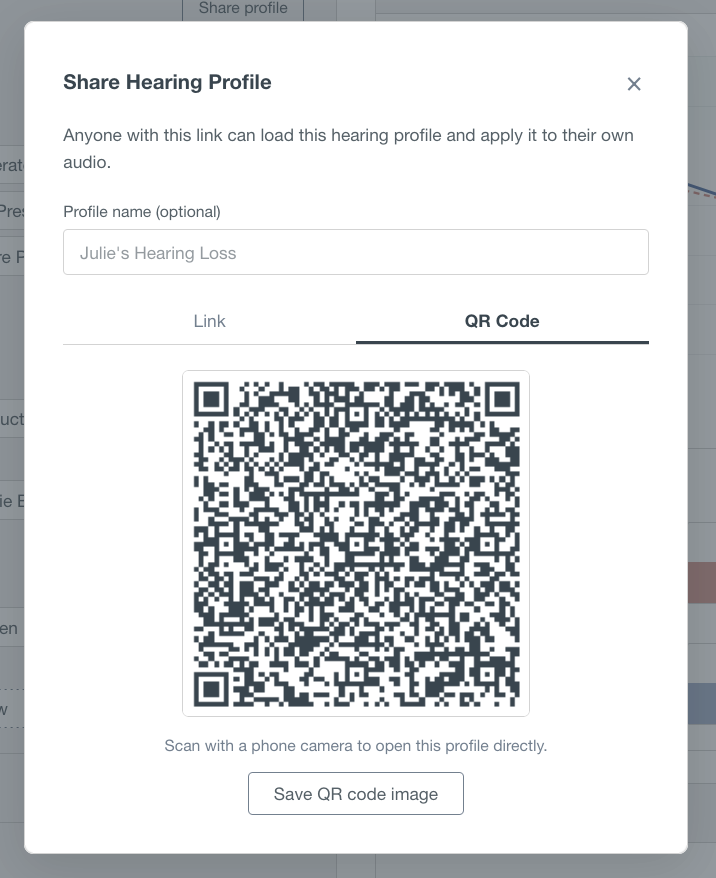
This simulation was built in JavaScript and runs entirely within the web browser. It uses audio files up to 25MB in MP3, M4P, WAV, FLAC, OGG, or OPUS formats. The hearing loss profiles can be shared via link or QR code. The audiogram display uses the standard clinical format (ISO 8253-1): blue X marks the left ear, red O marks the right ear. Custom audiograms can be created by entering dB HL values at each of the eight standard audiogram frequencies (250, 500, 1k, 2k, 3k, 4k, 6k, 8k Hz). The custom profiles are saved within a browser's localStorage and persist across sessions until deleted or the user clears their browser data. Tinnitus is adjustable but initially set to 4 kHz (just like mine).